

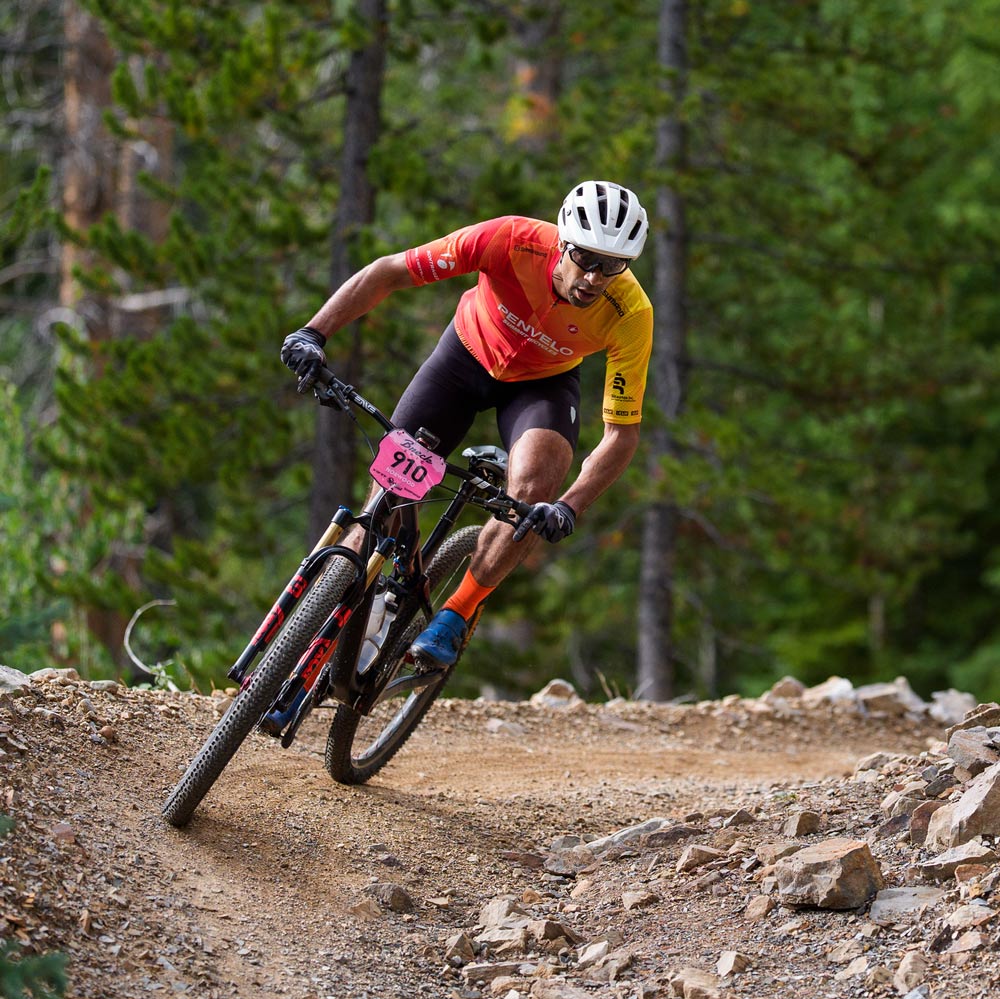
In conversation with Todd Norwood, physical therapist and competitive cyclist, on recovery, measurable performance, and what it takes to keep showing up day after day.
For endurance athletes, performance is often measured by what happens on the hardest day. Stage racing asks a different question: Can you do it again tomorrow?
For Todd Norwood, that question became very real at the Breck Epic, a six-day mountain bike stage race in Colorado. Starting at around 9,600 feet, with stages ranging from approximately 25 to 42 miles and 4,000 to 7,000 feet of climbing each day, the event represented completely new territory.
Norwood had raced bikes for more than 25 years, progressing from junior racing to earning a professional license before ultimately choosing a career in physical therapy. He has now practiced for around 15 years, with certifications in both orthopedic and sports physical therapy, while continuing to compete in masters cycling. But before Breck Epic, he had never raced for more than two consecutive days. Six days would require a different approach, not only to training, but to recovery.
That is where Unbroken entered the picture.
From one-day racing to a six-day challenge
Norwood has worked with coach Brian Freeze for approximately three years. When he told Freeze that he wanted to take on Breck Epic, the demands were immediately clear. This wasn't simply about becoming fit enough to complete one difficult race. It was about preparing the body to absorb repeated training loads and reproduce performance across six consecutive days.
"I'm normally a one-day race type of person," Norwood explains. "Endurance races, sure, long events, sure, but never more than one day."
Freeze recommended adding Unbroken to his training and recovery strategy. Norwood was interested, but his background meant he wasn't simply going to take the recommendation at face value. As both an athlete and a physical therapist, he wanted to understand what he was taking and why.
"I'm curious as a person, as an athlete, but as a therapist," he says. He researched Unbroken himself before deciding to incorporate it into his preparation. Then he watched what happened.

When recovery becomes measurable
Athletes often describe recovery through feel. Are the legs sore? Do they feel heavy? Does the body feel ready to train? Norwood pays attention to those signals, but he also has something many athletes don't: around 15 years of consistently tracked heart rate variability data.
"I've been doing heart rate variability since before it was cool," he jokes.
For Norwood, however, HRV is only one part of the picture. The real test happens when he gets back on the bike. What happens to heart rate at a given workload? How difficult does it feel to produce the same watts? Can those watts be reproduced the following day and maintained across several consecutive days?
His approach combines subjective feedback, physiological metrics, and actual performance. When he introduced Unbroken during his preparation for Breck Epic, he noticed a difference.
"The recovery from day to day was different than I had experienced before."
That mattered because his training load had changed substantially. Preparing for six days of racing required repeated hard sessions designed to simulate what he would eventually face in Colorado. The question wasn't whether he could complete one difficult training day. It was whether his body could recover sufficiently to make the next one productive too.
Less soreness. Very little performance degradation.
Once the race began, Norwood's recovery strategy became part of his daily rhythm. He used Unbroken after each stage and again before bed. He also incorporated it before and during the day's effort, including putting it into his final bottle on course.
"I try to start that recovery early and get that going since you had to be up and race the next day." Across six days, that repeatability became one of the most significant parts of his experience. Norwood expected fatigue and soreness, but what surprised him was how well his body continued to respond.
"I wasn't sore, but I was certainly less sore than I would have expected for what the demand of the race was." More importantly, the performance data remained remarkably consistent.
"Over the course of six days there was really very little degradation in performance."
For a stage racer, that changes the equation. A single explosive performance matters less if it comes at the expense of the following day. Stage racing rewards the athlete who can repeatedly produce a high level while fatigue accumulates around them.
As Norwood puts it: "If you can maintain a high level of performance across many days while your competitors are fatiguing, then you will be successful."
Second overall, and an unexpected result
Norwood entered Breck Epic without a clear performance expectation. The goal was to try something new, challenge himself, and see what happened when he moved beyond the type of racing he knew. Neither he nor his teammate knew exactly what day three, four, five, or six would feel like because they had simply never been there before.
Then the results started coming.
Norwood and his teammate ultimately finished second overall in the 80+ combined-age team competition. Across all team categories, regardless of age or classification, their performance would have placed them third overall.

"The result was a surprise in many ways," he says. "Wow, we got second place."
But perhaps more meaningful than the final position was what happened along the way. They remained consistent. Day three didn't produce the collapse they feared, and neither did day four or five.
"We didn't know on day three what was going to happen. That was all uncharted territory for us. So to see that we were consistent across the whole six days was refreshing."
Waking up on day five ready to race
Recovery isn't only physical. The prospect of another difficult stage feels very different when you wake up sore, heavy and exhausted compared with waking up feeling capable of attacking the day.
For Norwood, one of the most memorable aspects of Breck Epic was reaching the later stages and still feeling ready.
"I'm waking up on day five. I am ready to take on this challenge of what the course is asking of me today. My body feels ready. My body feels strong."
That physical readiness created something else: confidence. "It really gives you, I think, a mental edge going into the competition to know that you're feeling good and you're ready to go."
It is an important distinction. Good recovery isn't simply about feeling less uncomfortable after exercise. For an athlete, recovery creates the capacity and confidence to perform again. At Breck Epic, that meant waking up and knowing another mountain stage was possible.
A physical therapist's perspective on Unbroken
Norwood sees recovery from two perspectives. He is an athlete asking his own body to perform, but he is also a physical therapist whose professional life is built around helping others recover and regain function. That makes him naturally thoughtful about what he recommends.
Perhaps the strongest indication of his trust in Unbroken came away from cycling entirely. His mother recently underwent hip replacement surgery and, for Norwood, she was "the most important patient in my life."
Immediately after she returned home from the hospital, his focus was hydration and nutrition. He knew appetite could be difficult immediately after surgery, particularly alongside medication, while good nutrition remained important during the recovery period. Unbroken was one of the things he wanted her to have.
"You need to get nutrition and you need to start healing," he recalls telling her.
He encouraged her to take two per day during that early period because he wanted her to have a steady, easy-to-consume source of fast-absorbing amino acids. Four and a half months later, Norwood described her as almost back to normal and, in some respects, doing better than before surgery.
"That's probably the ultimate testament in my trust in Unbroken."
His mother's recovery involved many factors, and Norwood does not reduce that process to a single intervention. But from his perspective as a physical therapist, ensuring the body had appropriate nutritional resources available was an important part of supporting the recovery process.
Muscle is an investment in what comes next
Norwood's perspective on recovery extends beyond racing. As a physical therapist, he sees muscle as fundamental to long-term health. We naturally tend to lose muscle as we age, and remaining active can help counter that decline, but muscle matters for far more than physical strength alone.
"Muscles are just such an important part of our body for so many reasons. Not just the physical part, but from a metabolic standpoint, it plays such an important role in helping us maintain our health."
That makes recovery relevant far beyond competitive sport. Whether the goal is racing six days through the Colorado mountains, returning to activity after a demanding training block, or simply continuing to move well as we get older, the underlying principle is similar: training creates the stimulus, but the body still needs the opportunity and resources to rebuild.
Recovery is what allows you to keep building
Asked for his number-one recovery tip, Norwood doesn't start with supplements, technology, or performance metrics. He starts with the foundation: sleep.
"Make sure you get adequate sleep. It's so important." It reflects a philosophy that runs throughout his approach. There is no single shortcut to performance. Training, nutrition, sleep, recovery, and consistency work together, with Unbroken becoming one component within that broader system.
For Norwood, its value became clearest not in a laboratory or a single training session, but across six consecutive days when his body was repeatedly asked the same question:
Are you ready to go again?
At Breck Epic, the answer kept being yes.
"It's really incredible to experience that. Really empowering to be able to go and do something you haven't done before and feel good doing it."
Perhaps that is one of the most meaningful measures of recovery. Not simply how you feel after what you have already done, but whether you're ready for what comes next.
About Todd Norwood: Todd Norwood is a physical therapist with certifications in orthopedic and sports physical therapy and approximately 15 years of clinical experience. He is also a lifelong competitive cyclist who has raced for more than 25 years, progressing from junior competition to earning a professional license and now competing in masters cycling. In 2026, Norwood completed his first multi-day mountain bike stage race at the Breck Epic in Colorado, finishing second overall with his teammate in the 80+ combined-age team category.


